Websites for independent European auto repair shops.
Your customer is standing next to a German car with a light on the dash, holding a phone. Everything on the site has to work for him, right there, in that position. We build for BMW, Mercedes-Benz, Audi, and Porsche specialists — and you talk to the person writing the code.
Mobile-first is literal here, not a slogan
Most shops get sold a "mobile-friendly" site, which means the desktop layout squeezes down without breaking. That is a much smaller promise than it sounds. For a repair shop, the phone is not the secondary screen. It is the only screen. The person looking you up is in a parking lot, in a waiting room somewhere else, or on the shoulder with the hazards on. He has one hand free and no patience for a site that makes him wait.
So the design starts from that: your phone number tappable in the first screen without scrolling, your address opening the map app in one tap, your hours readable without pinching, and a quote form short enough to finish standing up. Heavy hero video and image carousels are the first things we cut, because on a weak cell signal outside a dealership they are what the visitor is waiting on.
We build these on Next.js and host on Vercel, so pages are served from a CDN near the person loading them. That is the boring infrastructure decision that does most of the work on a phone.
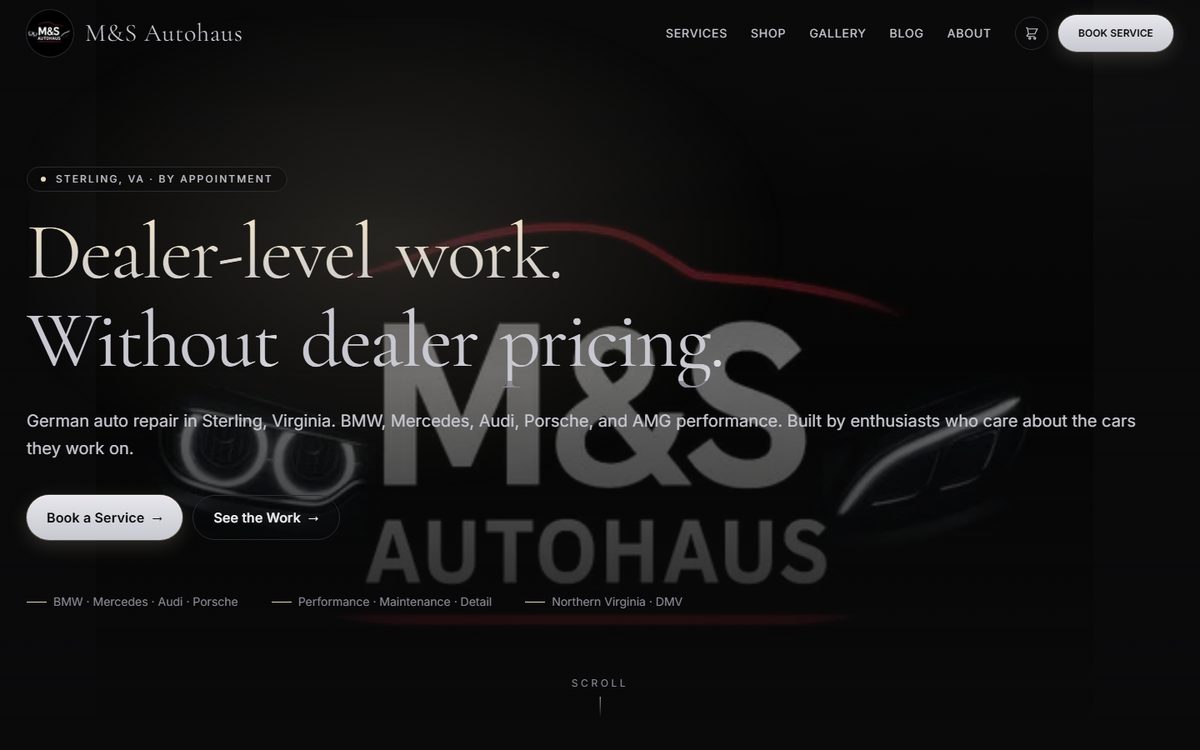
M&S Autohaus
A European auto specialist in Sterling, Virginia, working on BMW, Mercedes-Benz, Audi, and Porsche. Built mobile-first on Next.js, Framer Motion, and Vercel — the one client project running on its own apex domain.
Visit the live site ->A specialist shop should not look like every other repair shop
Template mills sell the same auto-repair website to every shop in the country. Stock photo of a wrench. A services grid with oil change, brakes, tires. A phone number in the footer. It is cheap, and it quietly erases the single most valuable thing about your business, which is that you are not a general shop.
An owner with an out-of-warranty E-Class is not searching for a mechanic. He is searching for someone who has seen his car before. The template buries that under generic service copy, because the template was written for a shop that does everything for everyone. When we build for a specialist, the specialization is the first thing on the page, and it stays visible in the navigation, in the page titles, and in the URLs.
What that looks like in practice
- The marques you actually work on, named plainly and high on the page, instead of a generic "foreign and domestic" line.
- Service presentation organized the way the customer thinks — by vehicle and by symptom, not only as an alphabetical list of repairs.
- Room to say what you decline. A shop that states which work it does not take reads as more credible, not less.
- The diagnostic equipment and factory-level tooling you have invested in, described in ordinary words, because that is the reason a customer drives past cheaper shops to reach you.
- How you actually operate. M&S Autohaus runs by appointment, and the site says so plainly rather than implying a waiting room and a queue.
None of that fits a template's content model. It fits fine in a site built for one business.
Third-party marks, built in properly
Trust on a repair-shop site comes partly from things the visitor knows you did not write yourself. In August 2026 we shipped a CARFAX section for M&S Autohaus, covering the shop's participation in the CARFAX Service Network: when a customer services the car there, eligible maintenance and repair records can be reported to CARFAX, so a documented service history follows the vehicle.
Two parts of that job are easy to get wrong. The first is the explanation. A badge means nothing to a customer who does not know what it does for his car, so the section says it in ordinary words and stays readable on a narrow screen. The second is trademark handling. The CARFAX name and logo belong to CARFAX, Inc., and the section carries an attribution line identifying the use as Service Network participation. That line is not decoration, and it is the sort of thing a template drops.
The same care applies to any outside mark or affiliation you carry: manufacturer training, certifications, parts and equipment brands, network memberships. Each one has terms attached to how it may be shown. We read them, we show the mark the way the owner permits, and we build the section so it degrades into plain text rather than leaving a broken panel on your site on a Saturday morning.
Reviews on a domain you own
The M&S Autohaus site carries a reviews section built from real reviews collected for the shop, each attributed to the customer who wrote it. Two things matter about that. The reviews are real, and they live on the shop's own domain instead of only on a platform that can change its layout, its ranking, or its terms whenever it likes.
Because the reviews are genuine and present on the page, the site can also carry review structured data honestly: the markup describes the same reviews a visitor can scroll down and read, attributed to the same people. That is the whole test. We will publish rating markup when real reviews back it, and we will not invent a star rating, pad a review count, or mark up reviews that are not on the page. Getting caught doing that costs a shop more than the stars are worth. For everything else you get structured data for what is verifiable — your business, your address, your hours, your services — and nothing beyond it. The same rule runs through the rest of the studio's work: no invented scores.
Quote requests and appointments a service writer can live with
The contact form is where most shop websites quietly fail. Either it asks for so much that nobody finishes it, or it asks for so little that your reply starts a phone-tag loop beginning with "what kind of car is it."
The version that works asks for the few fields that let you answer with something useful: year, make, model, roughly what it is doing, and how to reach the person. Photos and a short video say more than a paragraph of description, so the form takes them straight from the phone camera. Every submission goes to email, and where a shop wants it, to a text message with per-message delivery tracking, so nothing fails silently while the customer books somewhere else.
If you want appointments booked directly rather than requested, that is a larger build, and we will tell you so before you commit to it. We do the same routing and notification work at bigger scale — the lead marketplace we built and maintain matches and routes requests in real time, and we built a pickup and delivery site for a dry cleaner that takes customer requests the same way.
Local SEO when people search by car brand plus city
Your customer does not search "auto repair." He searches the marque and the place: the brand of his car, then his town or the one next to it. That is a different keyword shape from the generic term, and it is winnable by an independent shop, because the template mills are all fighting over the generic one.
Practically, that means real pages, not one page with a list of brands on it. A page per marque you specialize in, written with the actual work you do on those cars, with the city in the title tag and in the copy where it belongs and nowhere it does not. It means the business name, address, and phone number written identically everywhere they appear, because inconsistency there is a self-inflicted wound. And it means a sitemap submitted and Search Console connected at launch, so you can see the queries actually bringing people in instead of guessing.
We will not promise you a position on a results page. Nobody honest can. What we will do is build the pages that make you findable for the search your customer is really typing, then show you the search data so you can judge it yourself.
The build on record
How the work runs
One builder from the first call to launch. No account managers, no handoffs, nothing quietly sent offshore. When you email about a change on a Tuesday, the person who reads it is the person who edits the file.
Scope, fixed pricing, and a hard launch date get written down and signed off before a line of code gets written. There is no published price here, because the number depends on what you need. It is agreed before work starts and it does not move underneath you.
During the build you get daily deploys on preview URLs. You review the real thing live on your own phone, comment inline, and the change ships the same day. At launch we handle the apex DNS cutover, SSL, sitemap submission, Search Console and GA4 wiring, and real-device smoke tests before we call it live. Then we stay on afterward, because a shop website nobody maintains becomes a shop website with last year's hours on it.
If you run a specialist shop and the site is not doing its job, tell us what is broken. You will get a straight answer about whether it is worth rebuilding or worth fixing.
Your shop is not a general shop. Your site should say so.
Send the make and model mix you work on, your city, and your current site if you have one. You will get a plain answer about what to build and what to leave alone — from the person who would write the code, not a salesperson.